

frames of reference
imitation, self-reliance, and the question of authenticity

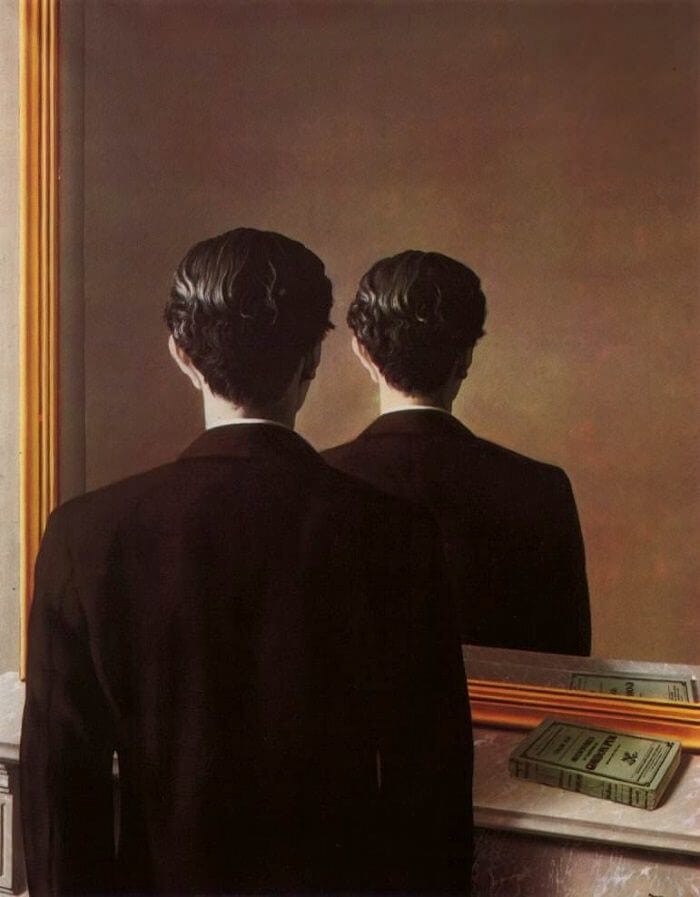
Ralph Waldo Emerson opens his 1841 essay, Self-Reliance, with the Latin phrase “Ne te quæsiveris extra” meaning “Do not seek outside yourself”— a charge to find your own truth within, to seek validation internally rather than outsource it to social trends, expectations, or the opinions of others.
When I was about seven, I believed I would make a fine lawyer. I don’t particularly remember why, only that I said it with total confidence, the way children usually do before they learn to doubt themselves. “The nonchalance of boys who are sure of a dinner […] is the healthy attitude of human nature,” Emerson writes; a boy, he says, gives an “independent, genuine verdict.” Soon enough, I was a teenager, and because I had the utmost admiration for my dad’s best friend, a surgeon, I began aspiring to become one myself. Ironically, and to my parents’ dismay, he was the first person to put the idea in my head that I should abandon surgery as a career ambition.
Looking back, I can’t think of a single defining moment when I ditched the idea and decided that medicine was not for me. But I remember that in almost every conversation I’ve had with my friends about it – a lot of whom are brilliant doctors themselves – I find myself mechanically repeating the phrases: “I could never do what you do,” “I doubt I could have made a successful doctor,” or “your job seems impossible.” Now, I’ve never done the job and so I have no basis for that verdict. This is, at its core, a question of self-reliance: how much of what we believe is actually ours?
Drawing a contrast between the boy, who judges the world around him on its merit, and the man, whose judgement has become entangled with the opinions of others, Emerson writes:
“But the man is, as it were, clapped into jail by his consciousness. As soon as he has once acted or spoken with éclat, he is a committed person, watched by the sympathy or the hatred of hundreds, whose affections must now enter into his account. There is no Lethe1 for this.”
These days, self-reliance is often dressed under aesthetic combinations of terms like personal branding, productivity culture, self-optimisation, and the truly inspired (if slightly hollow) “you can just do things.” However, the things we often consider our tastes are, more often than not, borrowed wants or aversions. René Girard’s theory of mimetic desires holds that human desire is fundamentally imitative. That is, all our longings are social.
From family, from friends, and, now with social media, from strangers to whom our very existence is unknown, we are a mosaic of small details picked up from one another. Girard’s core claim is that desire isn’t generated internally toward an object but borrowed from watching someone else desire that object. He called that other person the model. We don’t want things for what they are, we want them because someone else has shown us that they are worth wanting. And the same can be true for refusals: we learn what not to want by watching what others reject. That triangulation of self, model, and object, according to Girard, is the basis of desire. We “can just do things” by watching other people just do things.
Take ambition, for instance. You may believe you want a prestigious career in a certain industry, but that desire is often second-hand, absorbed from the people that you admire within that field. You believe you are pursuing success for your own sake, but success could mean different things to different people. Whose definition are you actually chasing? Even the shape of what counts as valuable may have been handed to you by someone else, long before you had a chance to decide for yourself. Conformity, thus, goes beyond copying what everyone else is doing, to inheriting the categories by which we decide what is worth doing in the first place.
Vincenzo Latronico’s Perfection follows Anna & Tom, a couple living in Berlin amid the sophisticated, polished, and affluent life of digital professionals. Their lives look enviable on the outside: complete with a beautiful, carefully designed apartment; traveling on a whim; cultural experiences; friends that are not quite friends; political engagement within their community; and an apparently sophisticated cosmopolitan identity. Latronico describes Anna & Tom as living “in a bubble, one even more insular and limited than those just starting to appear on social media…”
“[…] They inhabited a world where everyone accepted a line of coke, where no one was a doctor or a baker or a taxi driver or a middle school teacher. They spent all their time in plant-filled apartments and cafes with excellent wifi. In the long run it was inevitable they would convince themselves that nothing else existed.”
In a hyper-connected world, we are never truly alone with ourselves. The village has gone global and so have our frames of reference—there is more to desire, more people to mimic, more social groups seek belonging, more of everything that seems attainable. It gets harder to separate unthinking conformity from genuine choice.
Anna & Tom’s life, while appearing “clear, purposeful, and uncomplicated,” is really created by a series of fickle and temporary attachments—to places, people, tastes, politics, and ambitions—represented by a series of images on a screen. But as time passes, circles narrow or change, life changes, friends move on, and the life they have so carefully curated starts to lose coherence. Slowly, they realise that nothing about their life, not even its apparent individuality, is special. The dismal fact is that so much of what we do, and what we experience is not uniquely ours, so that even with the privilege of choice, we often end up unhappy because we are thrown into lives we do not really want. Latronico captures the paradox at the heart of their predicament:
“From the outside, it was easy enough to identify the cause of their alienation, but to them, paradoxically, no explanation revealed itself.”
In Self-Reliance, Emerson argued that society is a conspiracy against the personhood of its members, constantly pressuring each one into conformity until nothing of the individual is left, until the very condition of being a whole person is eroded. Where Girard believed that the self is shaped by imitation and that what we call our “individuality” is borrowed, Emerson believed that the self is the source of all truth and that beneath societal pressures, there is an authentic self capable of perceiving reality directly:
“There is a time in every man’s education when he arrives at the conviction that envy is ignorance; that imitation is suicide; that he must take himself for better, for worse, as his portion.”
Per Emerson, a reliable inner voice exists beneath the conformity. His remedy is to trust yourself. But this raises a Girardian question: how do you know that the inner voice itself isn’t mimetic? How would we know if the self we trust is itself a collage of borrowed wants and borrowed aversions? Even the conviction that we’ve thought something through alone, that we have arrived at a taste or an opinion independently, could be mimicry masqurading as originality.
The question, then, isn’t whether the self is autonomous; both thinkers reject that idea. The question is what the self participates in once autonomy falls away: for Emerson, a universal Spirit that speaks through the individual; for Girard, a relational order in which our desires remain mediated, and in which the decisive question becomes which model we imitate. We may never really know whether there is an authentic self beneath our wants and aversions, or whether our deepest convictions are truly our own. But perhaps we can still choose, with more care than we usually bother to, whose desires we let shape our own.
Sylvia.
Footnotes.
Lethe – (In Greek Mythology) a river in Hades whose water causes drinkers to forget their past.
Truthfully, before I learned what I wanted and did not want for myself, I judged these based on other people’s choices or what they rejected, accepted and showed me was possible. I told myself I could just do things because I saw others do same/similar.
I thoroughly enjoyed reading this ❤️
Brilliant! Totally enjoyed reading this to the end, resonated with my thoughts.